
CarmoForm announces an exclusive partnership with engineer Rune Abrahamsen until 2030
Rune Abrahamsen, the engineer behind the timber building that was once the tallest in the world, will serve as an executive consultant for the Portuguese company CarmoForm, exclusively for the Iberian Peninsula. An international conference brought together around 400 participants of various nationalities yesterday in Lisbon and will move on to Madrid on 29 October.
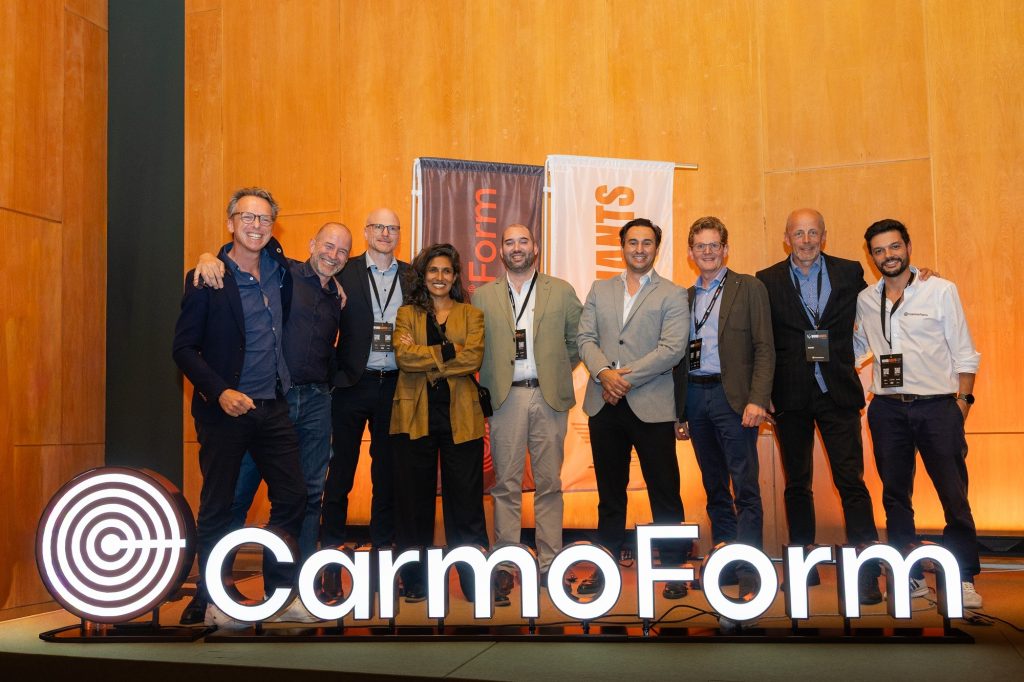
CarmoForm has just announced an exclusive strategic partnership with Rune Abrahamsen, one of the leading international figures in timber engineering, during the first edition of Wood Giants, an international conference which brought together around 400 participants of various nationalities today at the National Laboratory for Civil Engineering (LNEC) in Lisbon. The agreement, valid until the end of 2030, reinforces the Portuguese company’s growth strategy in the Iberian Peninsula and marks the highlight of this event, which focused on timber construction as a response to the challenges of housing, industrialisation and the decarbonisation of the sector.
With over 30 years’ experience, Rune Abrahamsen led the team responsible for the timber structures of Mjøstårnet, an 18-storey Norwegian building which, upon its completion in 2019, was the world’s tallest building constructed from this material. As part of the partnership with CarmoForm, Rune will take on the role of executive consultant for the Portuguese company on projects in Portugal and Spain, providing strategic, technical and commercial advice, particularly during the initial stages of development.
Timber construction: from innovation to industrial scale
Organised by CarmoForm, Wood Giants brought together international experts involved in leading projects across Europe, demonstrating that timber construction has moved beyond the experimental phase and now offers technical solutions to meet the needs of buildings of different scales and types.
The opening session featured Patrícia Gonçalves Costa, Secretary of State for Housing, who emphasised the urgent need to build more, faster and better, advocating industrialisation, planning and the efficient use of materials as ways to meet the country’s housing needs.
Throughout the conference, Rune Abrahamsen presented the experience of the Mjøstårnet project, emphasising the importance of developers’ ambition, collaboration between different stakeholders and the involvement of policy-makers in bringing pioneering projects to fruition. Florian Kosche, the engineer responsible for the structural development of the Sara Kulturhus in Sweden, demonstrated how timber engineering enables the construction of highly complex buildings, such as this 20-storey project, whilst meeting structural requirements and withstanding extreme weather conditions.
The economic and environmental aspects were also at the heart of the debate. Bernhard Egert, head of timber construction and sustainable buildings at UBM Development, presented the property investment perspective, drawing on the experience of the LeopoldQuartier in Vienna. He argued that the sector’s greatest potential for transformation lies not only in iconic high-rise buildings, but above all in the widespread adoption of timber construction in medium-rise buildings – particularly those with six storeys – where there is greater market scale and scope for reducing emissions.
For his part, Pablo van der Lugt, a specialist in bio-based materials, highlighted the role of timber in the decarbonisation of cities, emphasising the importance of public policy, responsible forest management and the circular economy. Among the examples presented was Stockholm Wood City, a planned urban development in Sweden covering around 250,000 square metres, comprising 2,000 homes and with the capacity to accommodate 7,000 jobs.
One of the most striking examples of the structural and commercial advantages of timber was presented by the British architect Andrew Waugh, founder of the practice Waugh Thistleton Architects. His Black & White Building in London saw its timber structure erected in just 14 weeks and, according to the architect, currently has an 18-month waiting list for new tenants in its co-working spaces. Waugh highlighted the construction sector’s lag behind other sectors in reducing its environmental impact and emphasised the responsibility of architects and engineers in the choice of materials, as well as the importance of research and the open sharing of knowledge to accelerate the industry’s transformation.
Portuguese architect Vanda Oliveira, from Henning Larsen, presented the ‘World of Volvo’ project in Gothenburg, highlighting the importance of ongoing collaboration between architects, engineers, builders and other stakeholders. The experience of this project demonstrated how the integration of different disciplines, from design to execution, is crucial to realising innovative and technically demanding architectural solutions.
For João Figueiredo, CEO of CarmoForm, attendance at the conference – which exceeded the organisers’ expectations – confirms the need to bring international expertise closer to professionals and decision-makers in the Iberian market.
“Wood Giants exceeded all our expectations. We brought together around 400 participants of various nationalities, in a clear demonstration of the enormous desire within the market to find answers, discover new solutions and dispel the preconceptions that still hold back timber construction. It is particularly gratifying to see a 100 per cent Portuguese company have the courage to bring this debate into the public arena, bringing together professionals, companies and even competitors under one roof, to learn from those who, in other markets, have long since stopped questioning timber as a construction solution and are already exploiting its full potential. “We want to contribute to a real change in the way we build in the Iberian Peninsula, and this first event has shown that the sector is open to this transformation,” he states.
The success of the first edition reinforces CarmoForm’s ambition to position Wood Giants as an Iberian platform for knowledge-sharing and for bringing together engineering, architecture, construction, investment and public decision-makers.
Following Lisbon, Wood Giants heads to Madrid on 29 October, where the second edition of the conference will take place at the IETcc-CSIC – Eduardo Torroja Institute of Construction Sciences, continuing the debate on the future of timber construction in the Iberian Peninsula.